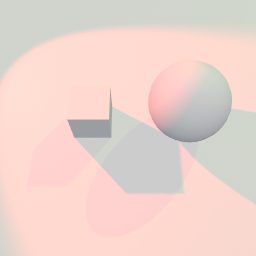
A directional light and a spot light casting onto the same ground, side by side. It is the light's side of shadows: whether it casts at all, and the resolution, bias and softness underneath that.
geo/DirectionalLight geo/SpotLight
Documentation / Node reference / geo nodes
A light infinitely far away, casting parallel rays like the sun.
Lights
The light direction comes from the node's rotation; its position does not affect the lighting. Aim it with an upstream transform (geo/PolarTransform points it at the origin). Shadows are rendered with an orthographic camera looking along the light direction: the size param sets the world area the shadow map covers.
| Name | Type | What it does |
|---|---|---|
| color | Color | Light color. |
| intensity | Float | Light brightness. Scales the color's contribution. |
| displayHelper | UInt8 ONLY_IN_EDITOR · ALWAYS · NEVER | When to draw the light's viewport helper. |
| helperSize | Float | Scale of the viewport helper. Display only. |
| size | Float | Half-extent of the orthographic shadow frustum, in world units. The shadow map covers a box of twice this size around the light axis: keep it as small as the scene allows so the texels concentrate on it. |
| castShadow | Bool | Whether this light casts shadows. The shadow params below only apply when this is on. |
| resolution | Vector2UInt | Shadow map size, in texels. Higher is sharper and costs more memory. It does not change how soft the shadow reads: bias and normalBias are expressed in texels and softness is a fraction of the light's frustum, so the shadow keeps its proportions when the resolution changes. |
| near | Float | Closest distance the shadow camera records. Casters closer to the light than this are not in the shadow map. |
| far | Float | Farthest distance the shadow camera records. Casters beyond it are not in the shadow map. Near and far only bound the recorded range: shadow position, contact and bias behavior do not depend on them. |
| bias | Float | Manual depth-bias adjustment, in units of 8 shadow-map texels. Leave at 0 for most scenes: an automatic bias (a small floor plus a slope-scaled term) already prevents self-shadowing. Negative values pull the shadow tighter to the contact point, at the risk of surface acne. Positive values push it away from the caster. The effect is independent of the near/far range. |
| normalBias | Float | Offsets the shadow lookup along the surface normal, in shadow-map texels. The default of 1 clears residual acne on curved surfaces. Large values visibly shift the shadow away from the caster. |
| amount | Float | Shadow strength. 1 is a full shadow, 0 removes the darkening entirely. |
| filterMode | UInt8 HARD · PCF · SOFT | HARD is a single crisp comparison per pixel. PCF blurs the edge with a fixed-radius filter. SOFT is PCSS: the penumbra is sharp at contact and widens with the caster-to-receiver distance. PCF and SOFT both take their width from softness. |
| softness | Float | Apparent size of this light source, and so how soft its shadow is. Larger is softer, 0 is a hard edge. One number for every shadow the light casts: the PCF blur radius under filterMode PCF, the penumbra width under SOFT, and the light's angular width on an SDF object, which marches its own field instead of reading the map and so softens whatever castShadow says. It is a fraction of the light's frustum, not a count of texels, so raising the shadow resolution sharpens the map without narrowing the soft edge. The same value does not read as equally soft in PCF and in SOFT: SOFT scales it by the caster-to-receiver distance. |
Scenes you can open in the editor that teach this node.
A directional light and a spot light casting onto the same ground, side by side. It is the light's side of shadows: whether it casts at all, and the resolution, bias and softness underneath that.
geo/DirectionalLight geo/SpotLight
This page is generated from the engine, so it describes the release you can download. The same text is in the editor's Help panel next to the node itself.