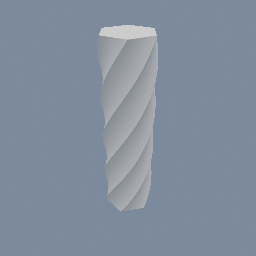
A six-sided prism spiralled into a fluted column by one node, with no repetition anywhere. Drag the rate and watch it wind up.
geo/SDFTwist
Documentation / Node reference / geo nodes
Spirals an SDF object about an axis, tighter the further along it you go.
Sdf Operations
Turns each input SDF object about `axis` by `rate` radians for every unit along that axis, so a straight extrusion comes out as a spiral and a box comes out as a twisted column. It wraps the whole upstream field, so a composed tree twists as one shape rather than piece by piece.
The exact map: a sample at distance d along the axis from `center` is turned about the axis by rate * d before the input reads it, which makes the shape itself appear turned the other way by the same angle. So `center` is both the plane where the twist is zero and the line it turns about, and a positive rate spirals right-handedly about the positive axis.
This is the family's first operation that is NOT distance-preserving. A turn on its own moves a shape without stretching it, but a turn that varies along the axis shears the space, so the field reports a bound rather than a true distance. The renderer handles it: the object's march step is scaled down by exactly how much this twist can stretch a gradient, which is worked out from the rate and from how wide the input is. A narrow shape given a gentle twist costs nothing, and a wide plate given a hard one costs march steps rather than correctness.
Bounds become the input's box swept about the axis, so the cross-section is the circle that fits around it.
It takes a 3D field. A 2D one has no axis to twist about, so it is an error rather than a no-op: extrude or revolve the 2D field first. Non-SDF objects pass through unchanged.
| Name | Type | What it does |
|---|---|---|
| axis | UInt8 X · Y · Z | Which world axis the shape spirals about. For a tilted axis, wrap this node in a geo/Transform in GEOMETRY mode. |
| center | Vector3 | The point the axis passes through: both the line the shape turns about and the plane where the twist is zero. |
| rate | Float | Radians of turn per unit along the axis. The sign is the handedness, so a negative rate spirals the other way. |
Scenes you can open in the editor that teach this node.
A six-sided prism spiralled into a fluted column by one node, with no repetition anywhere. Drag the rate and watch it wind up.
geo/SDFTwist
This page is generated from the engine, so it describes the release you can download. The same text is in the editor's Help panel next to the node itself.