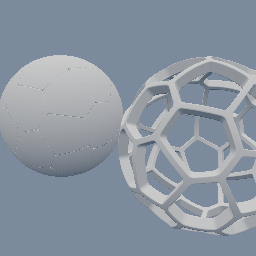
Joins every point to its Voronoi neighbours, the points whose cells touch its own, with one segment per pair.
Every point owns a Voronoi cell, the part of space closer to it than to any other point. Two points are neighbours when their cells share a face. This node keeps the points as they are and adds one segment between every two neighbours (the Delaunay edges of the points).
**What it is for.** geo/VoronoiField needs it on its points input for its SDF output: the neighbours are then found once, when the points change, and changing the wall thickness or the rounding stays cheap. geo/VoronoiCells takes it too, and builds its cells much faster with many points. Plug it straight into either node. A node between them that moves the points (a jitter, a non-uniform scale) leaves segments that no longer join neighbours, and the cells come out wrong.
Each input object gives one output object. To break a shape with points from several objects, merge them first with geo/Merge.
Scenes you can open in the editor that teach this node.
This page is generated from the engine, so it describes the release you can download. The same text
is in the editor's Help panel next to the node itself.