Documentation / Node reference / geo nodes

geo/VoronoiField

Breaks the mesh on input 0 into Voronoi cells around the points on input 1, with rounded or sharp cell edges.

Mesh

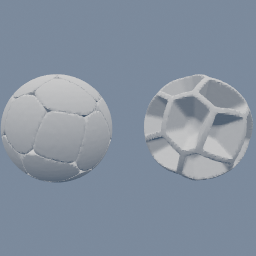
Every point on input 1 owns the part of the mesh that is closer to it than to any other point. CELLS gives one piece per point, ready to fall apart or to be exploded with a transform per piece. WALLS keeps only the walls between the pieces, a honeycomb or foam of the mesh. STRUTS keeps round struts along the edges where the pieces meet, a lattice of the mesh, with smooth joints.

**`smoothness` goes from hard to organic.** At 0 the cells are flat-faced polyhedra with sharp edges. Raise it and every edge and corner of a cell is rounded with that radius, until the pieces look like pebbles. The outside of the mesh is never rounded: only the faces the cells cut are.

Every face carries the `CELL_ID` attribute, the index of the point whose cell it belongs to, and the faces cut inside the mesh are in the `cut` group, so geo/Material can give the inside of the pieces its own material.

Points spread evenly give even cells: geo/Scatter with POISSON_DISK, or geo/PointRelax after a scatter. The mesh should be closed, since its inside is found by flooding the space around it. `voxel size` is the resolution: a cell or a wall thinner than a voxel is lost, and halving it costs about eight times the time.

Parameters

Name Type What it does
mode UInt8 CELLS · WALLS · STRUTS CELLS gives one piece per point. WALLS gives the walls between the pieces, as one mesh. STRUTS gives round struts along the edges where the pieces meet, as one mesh.
smoothness Float Radius of the rounding of the cells' edges and corners, in world units. 0 keeps them sharp. The outside of the mesh is not rounded. On STRUTS, it fillets the joints where struts meet.
wallThickness Float WALLS only: how thick the walls are, in world units. Keep it at least two and a half times `voxel size`, or the walls get holes; the node warns when it is thinner.
strutRadius Float STRUTS only: the radius of the struts, in world units. Keep the diameter at least two and a half times `voxel size`, or the struts get holes; the node warns when it is thinner.
voxelSize Float Edge of one grid cell, in world units. This is the resolution: a piece or a wall thinner than this is lost.
maxResolution Vector3UInt Ceiling on the grid size per axis, so a small voxel size on a large mesh cannot run away with memory and time. Hitting it cuts the grid short rather than coarsening it.

Examples

Scenes you can open in the editor that teach this node.

A sphere broken into the Voronoi cells of evenly spread points. On the left, every cell is a pebble with rounded cut edges. On the right, only the walls between the cells are kept, a foam skeleton of the sphere. Change `smoothness` to go from sharp shards to round pebbles.

geo/VoronoiField geo/PointRelax

Modeling

See also

This page is generated from the engine, so it describes the release you can download. The same text is in the editor's Help panel next to the node itself.